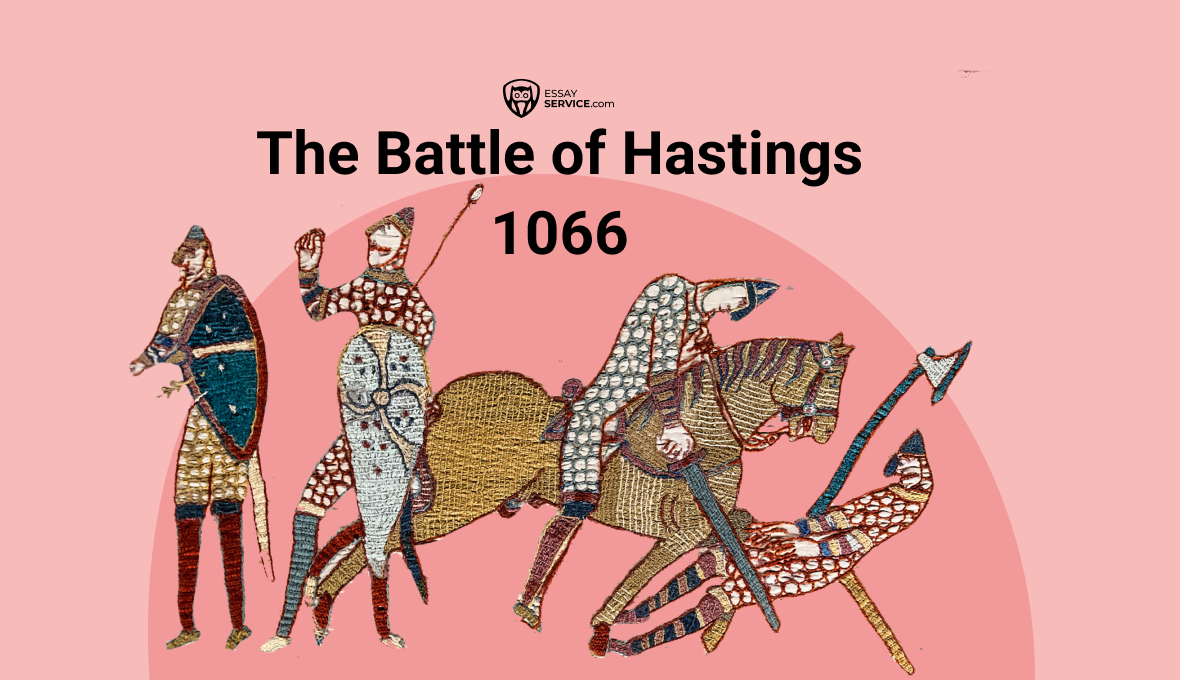

You don’t have to be a history major to take an interest in cool historical events. The battle of Hastings warrants plenty of attention from any history enthusiast out there, including our write my essay service. However, if you actually are a history major, there is no way you won’t run into this battle somewhere along the way of your studies.
It is a complex and layered topic that you can pour hours of research into. A lot of professors out there are of the same opinion. And that’s why they love to give their students plenty of assignments on this subject. So, you will have to get to know this event better in any case - why not start now? Once you get into it, you might just find it more fun than you initially expected.
Battle of Hastings 1066, Start
The backdrop for this epic showdown is the passing of Edward the Confessor - the king of England. Many writing services put their effort into researching the complex topic of Edward’s inheritance. He had no children and, thus, no direct successors to his throne.
Fortunately, there wasn’t a lack of people eager to inherit his position. The nobility of England as well as some surrounding countries have searched for an excuse to claim the crown. Three were able to find such an excuse and muster enough swords to enforce it.
Harold Godwinson being closer than others to the crown proclaimed himself king on the very day Edward the Confessor died. But once the word spread out, more contenders for the throne emerged: William the Bastard - the duke of Normandy - and Harald Hardrada - the king of Norway.
The battle of Hastings 1066 took place during this crisis of succession and effectively put an end to it. And the aftermath of this battle has shaped England as we know it today.

Battle of Hastings Facts
Any history essay writer will tell you that the 1066 battle of Hastings itself was long overdue. Once William heard that Godwinson had stolen the title he intended to rightfully usurp, he sent an envoy to politely ask for the crown back. After getting a negative answer he gathered his men and set off for London intending to settle this business with good old violence.
Unfortunately, he was unable to get to England from the mainland due to unfavorable winds. So, the two armies sat on the opposite sides of the channel awkwardly, waiting for something to happen. This went on for quite a while until Godwinson and his men got bored and went home to care for their fields.

Naturally, after they left the wind changed, allowing William to cross the channel and start ransacking the coastal villages. It's near one of such villages that William’s army met with the returning Godwinson. Let’s talk a bit about the leaders of these two armies.
Harold Godwinson
Harold Godwinson was the de facto ruler of England at the time the battle of Hastings 1066 took place. Although he had a lot of influence in the country and the support of the nobility, he wasn’t a descendant of the previous king.
Yet, he was much closer to the king than all of his blood relatives and was already serving as his close advisor. That made him the perfect candidate to take the crown.
Despite the way the politics worked, there were plenty of other people who felt like they were denied their right to the throne because of Godwinson. Those complex political games may become a reason why you might want to get the help of an essay writing service to get to the bottom of it.
William the Conqueror
William the Conqueror was the duke of neighboring Normandy. He was a very influential person and had good relations with King Edward to the point where he was (allegedly) promised that he would inherit the throne of England after King Edward dies. Moreover, Harold Godwinson pledged his allegiance to William before this ordeal happened.
Whether all these things had any substantial weight for them when it came to the claim on the throne is debatable. The topic is certainly obscure enough to buy essay online to figure it out. But it didn’t really matter as William decided to gather his troops and sail to England anyways after getting the blessing of the church.
William of Normandy Battle
When William the Conqueror landed in south England, Harold Godwinson was celebrating his victory over Harald Hardrada. He considered staying in London to wait for William’s advance. But it was ultimately decided to march and meet William’s forces in an anglo saxons battle after news of William burning down the coastal villages reached Godwinson.
So, Godwinson gathered his troops and marched south. The two armies met just north of Hastings with Godwinson taking an advantageous position on top of the hill. The battle began early the next day and ended in Godwinson’s defeat with him being killed in the process.
How Long the Battle of Hastings Last
Historical records show that the 1066 battle of Hastings occurred on the 14th of October 1066. It started at about 9 in the morning and lasted the whole day until dusk.
It does seem unusually long even for a medieval battle. But we have to consider the sheer scale of this encounter. A huge number of troops clashed in what resembled more of a siege scenario with Godwinson holding the hill and William trying to take it by sending wave after wave of soldiers up there.
Who Fought in the Battle of Hastings
The army compositions were pretty standard for the time of the 1066 battle of Hastings. Archers, infantry, as well as cavalry, were present in both armies. William’s men were mostly normans while Harold Godwinson obviously brought his Anglo-Saxon conscripts and nobility. Both armies mostly consisted of peasants with mercenaries sprinkled in. Commanding positions were reserved for nobles.
Who Did William the Conqueror Defeat at the Battle of Hastings?
The victory didn’t come easy to William the Conqueror in the battle of Hastings 1066. Harold Godwinson held an advantageous position on the top of the hill. The ascend was exhausting to the point where even cavalry attacks didn’t have much effect.
But after countless unsuccessful attempts to take the hill, William’s front line turned around and retreated for reasons unknown to this day. The defenders thought that they had won and pursued the retreating footmen downhill, abandoning their ranks. This has allowed William’s reserves to counter charge and make short work of the now disorganized enemy forces.
Why the Battle of Hastings Was Important
The battle of Hastings 1066 was very important to England as were the events surrounding it. Not because of the power struggle - kings were replaced fairly regularly back in those tumultuous times. The thing that gave it so much historical significance was the doors from the mainland to the isles the 1066 battle of Hastings has opened.
With the victory over the Anglo-Saxon king, William has effectively started a huge cultural merger. And we can see the consequences of that process to this day. It has affected the architecture as well as the language and marked the beginning of a new era in the history of England.
William's Battle Force, Battle of Hastings
The scale of the battle of Hastings was pretty impressive. William’s battle force consisted of about seven to twelve thousand soldiers of infantry and cavalry. They were facing an (literally) uphill battle against about five to thirteen thousand people on Godwinson’s side.
The exact number is hard to estimate as historical records can sometimes be unreliable. But even by the most modest calculations, it was a pretty big battle. You might decide to order essay if you want a more precise estimation.
Battle of Fulford, the Battle of Hastings 1066
But what happened to the third king that tried to claim the throne of England? Harald Hardrada was dealt with way before the battle of Hastings started. The battle of Fulford was one of his few victories that he managed to achieve at the beginning of his northern invasion. And although it would be super exciting to see a real full-blown Viking invasion, he got defeated and killed by Harold Godwinson’s forces shortly after the battle of Fulford.
What Happened After the Battle of Hastings
As it goes, a sudden change of management didn’t sit well with most of the country’s nobility. So, William had to spend the next few years on an exhaustive campaign, quelling revolts all around his newly conquered lands. The campaign was successful in solidifying William’s rule. After it was finished, the changes he intended to introduce got more traction.
Anglo-Saxon nobility was replaced by William’s Norman friends who introduced the wonders of Norman architecture by creating some of the most impressive sites that have been attracting tourists to this day.

Battle of Hastings Summary
The 1066 battle of Hastings was a pretty interesting historical event. Of course, there were plenty of other even more epic battles like the battle of Thermopylae or the fields of Verdun. But few can rival this particular encounter when it comes to the sheer cultural impact.
It is hard to overestimate the importance of the chain of events the 1066 battle of Hastings triggered. And if you enjoy looking into these sorts of things, you might want to write essays for money in the future. Today, it’s easier than ever as we have the opportunity to witness this domino effect that the events of the past have. That is the beauty of studying history.
Frequently asked questions
You Might Also Like



New Posts to Your Inbox!
Your submission has been received!